Krill Design announces the successful completion of the “SUSTAINABLE FU(RNI)TURE” project, funded under the “Ricerca & Innova” call promoted by Regione Lombardia through the ERDF Regional Programme 2021–2027 and co-financed by the European Union.
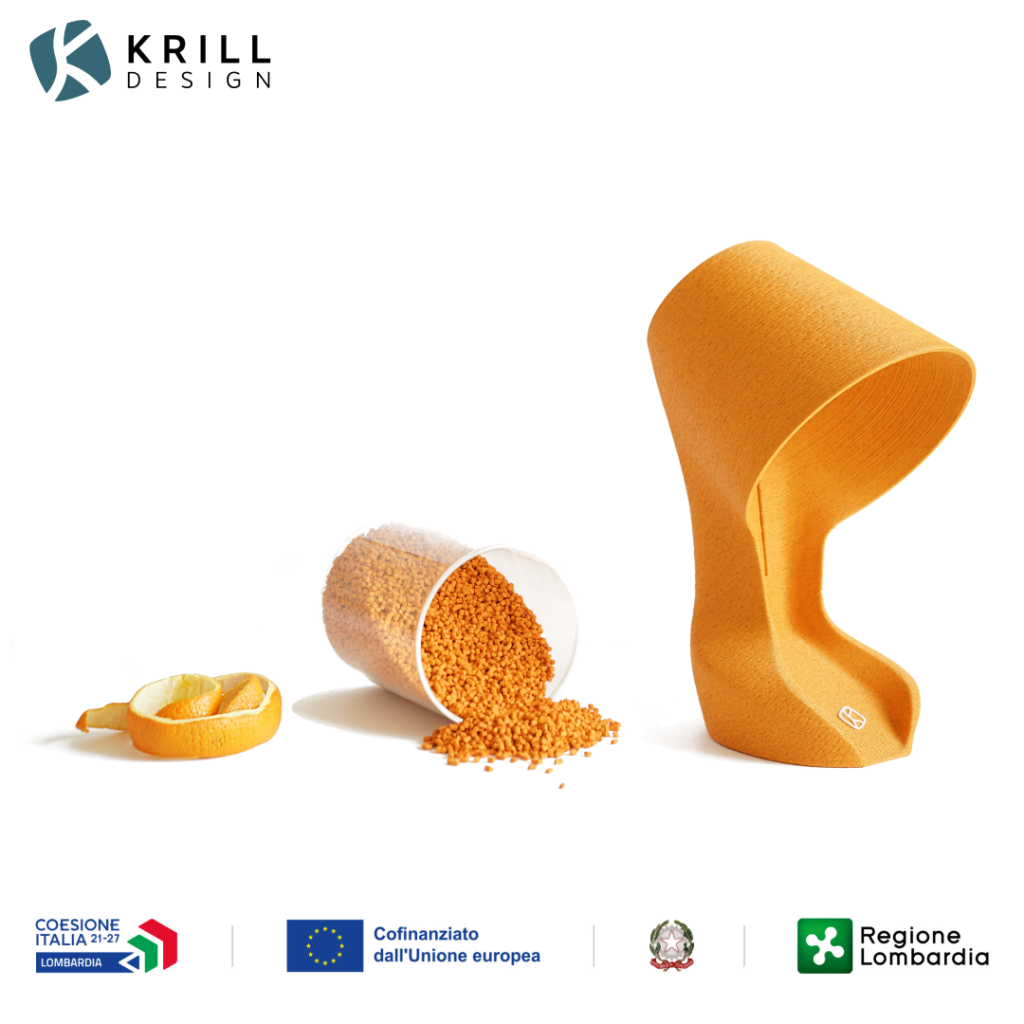
At the core of Krill Design’s two-year SUSTAINABLE FU(RNI)TURE project is the development of new circular and sustainable solutions for the eco-design and furniture sector, achieved by upcycling food-industry by-products—such as peels, seeds, and shells—into innovative biomaterials for the production of furniture and design objects.
The project represents a significant step toward a future in which design, sustainability, and technology converge to create shared value. Thanks to this initiative, “Krill Design has strengthened its role as a pioneer in the circular economy applied to the creative industry,” states the Krill Design team.
At the heart of Krill Design’s solution within the SUSTAINABLE FU(RNI)TURE project lies REKRILL®, a patented material engineered to deliver the technical reliability of traditional plastics without their environmental impact.
REKRILL® is not just a material, but a narrative. It becomes a tangible way to express values, vision, and commitment to the planet. Its tactile qualities, material depth, and natural origin allow it to convey meaning beyond function.
“REKRILL® does not replace plastic through imitation,” says Ivan Calimani, CEO and Founder of Krill Design. “It does so by changing the rules and offering a new starting point rooted in regeneration, actively reducing dependence on virgin resources.”
Unlike petrochemical plastics and first-generation biopolymers, REKRILL® is fully bio-based and compostable—even in marine environments—without releasing microplastics or toxic residues. In terms of CO₂ savings, the benefits are substantial, with up to 67% lower emissions compared to conventional plastics.
The initiative was developed within Action 1.1.1 “Support for investments in research, development and innovation”, promoting a short and circular supply chain that integrates scientific know-how, sustainable design, and local production.
Key outcomes of the project include the formulation of new food-waste-based biopolymers for 3D printing, the development of new eco-design products for small and medium-sized furniture, and the validation of a production model that can be replicated across other territories and industrial contexts.
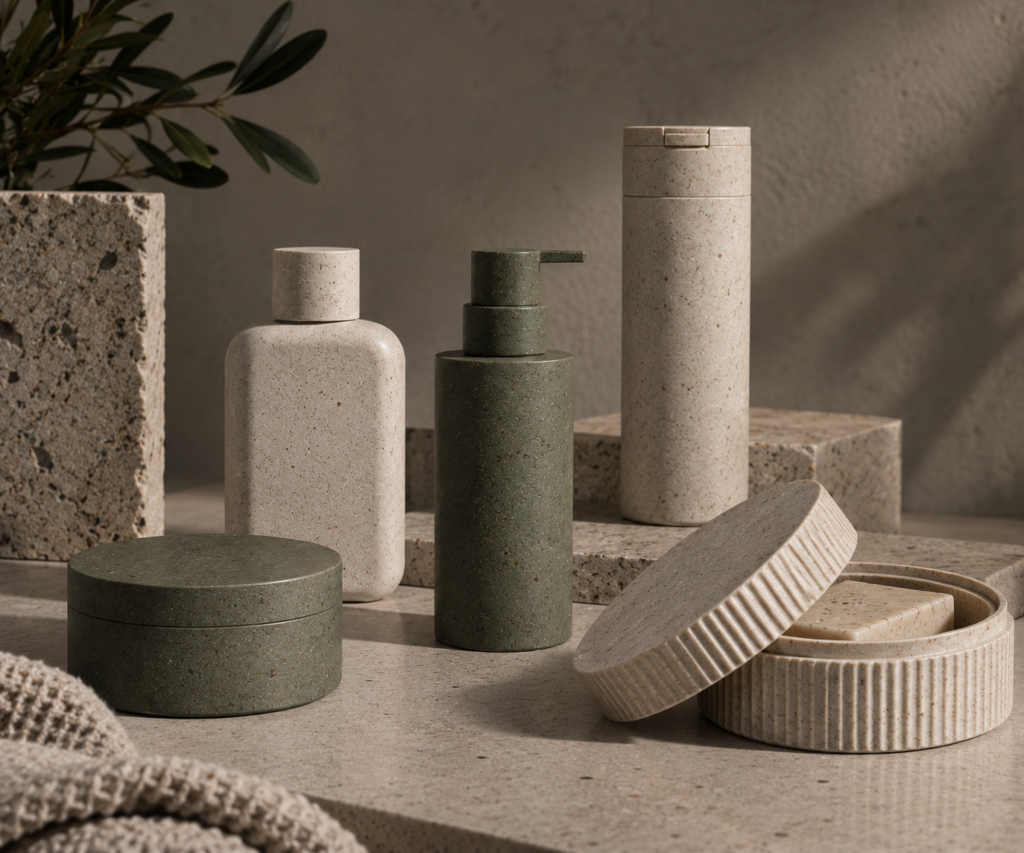
These results are made tangible through the creation and production of new eco-design collections and products made from orange peels, lemon peels, and coffee grounds, as well as through the testing and development of new bio-material formulations derived from shells, seeds, and by-products of the cereal supply chain, suitable for application across multiple sectors.
The conclusion of the project also marks the beginning of new growth perspectives: Krill Design now aims at the industrialization and internationalization of the developed solutions, with the goal of making a concrete contribution to European objectives for ecological transition and climate neutrality.