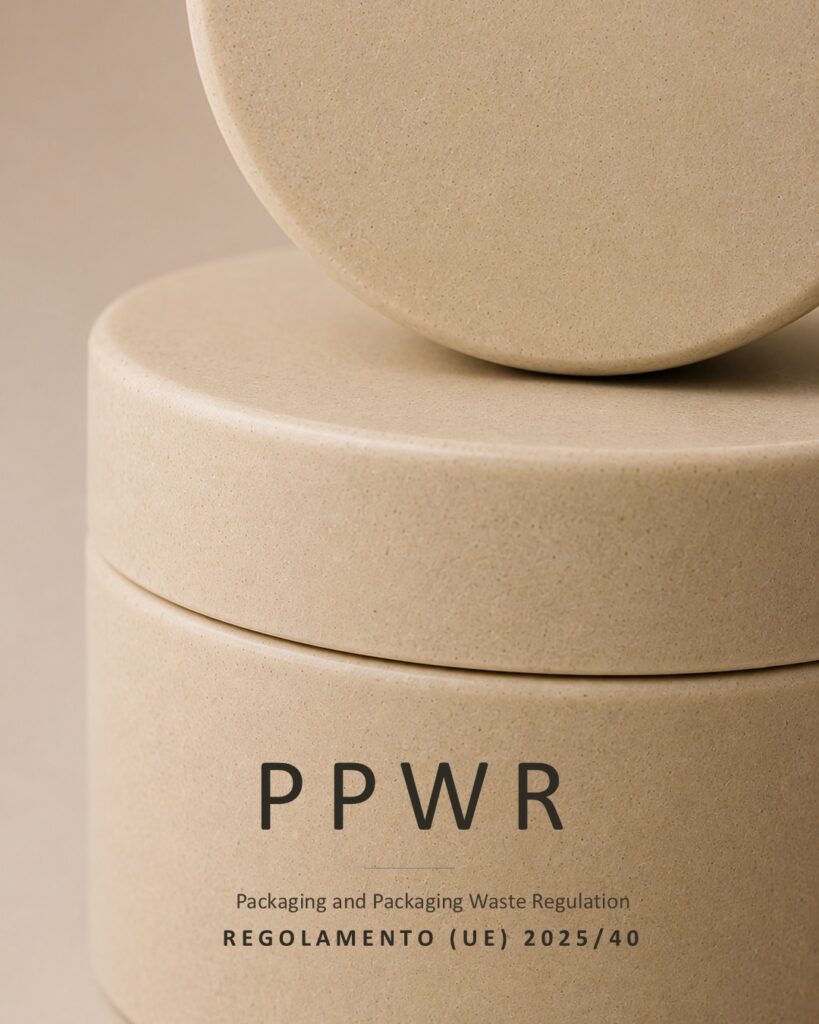
The PPWR is Regulation (EU) 2025/40 on packaging and packaging waste, applicable from August 12, 2026 in all EU Member States. It introduces requirements on recyclability, recycled content, substances, and documentation, and shifts the assessment from how packaging is produced to what happens to it after use. For those developing packaging, this means that material selection is no longer determined solely by performance and cost, but also by compatibility with existing recycling streams, raw material origin, and the ability to demonstrate compliance with a technical dossier.
What is PPWR and from when does it apply?
The PPWR (Packaging and Packaging Waste Regulation) is the European regulation on packaging and packaging waste. It entered into force on February 11, 2025 and applies from August 12, 2026.
It replaces Directive 94/62/EC, and the difference is substantial: a directive must be transposed by each Member State through national legislation, whereas a regulation applies directly and uniformly throughout the Union. The rules are therefore identical in every European market where you sell.
The stated objective is to:
- reduce the quantity of packaging waste
- increase material circularity
- improve packaging management throughout its entire life cycle.
What the PPWR entails: Key Obligations
The regulation revolves around a set of requirements that enter into force at different times.
- Substances (Art. 5). Cumulative limit of 100 mg/kg for lead, cadmium, mercury, and hexavalent chromium. Ban on PFAS in food contact packaging. In force from August 12, 2026.
- Documentation (Art. 15). EU declaration of conformity and technical dossier for each packaging type, from August 12, 2026.
- Recyclability (Art. 6). From January 1, 2030, all packaging must be designed for recycling and achieve at least class C, meaning 70% recyclable by weight. From 2038, only classes A (from 95%) and B (from 80%) remain permitted.
- Recycled content (Art. 7). From 2030, each plastic component must contain a minimum quota of post-consumer recycled content, from 10% to 35% depending on type, with higher thresholds from 2040.
- Compostability (Art. 9). Mandatory by February 12, 2028 only for tea and coffee bags, flexible single-dose portions disposed of with their contents, and adhesive labels on fruit and vegetables. Member States may extend the list.
- Minimization and reuse (Art. 10 and 11). Reduction of weight and volume, 50% limit on empty space, requirements for reusable packaging.
- Harmonized labeling (Art. 12), from August 12, 2028.
These are complemented by bans on certain single-use formats listed in Annex V, in force from 2030, and extended producer responsibility, with contributions modulated on the environmental performance of the packaging.
What Changes for Packaging Manufacturers
The shift in approach is singular: the assessment no longer focuses solely on how a material is produced, but also on what happens after its use. Material selection must therefore take into account 3 aspects.
1. Material Recyclability
The PPWR requires that packaging can be genuinely recovered through efficient recycling systems. This means designing materials compatible with existing infrastructure, avoiding solutions that are difficult to separate or manage at end of life. From 2035, design alone will no longer suffice: recyclability “at scale” will be required, meaning collection, sorting, and recycling actually operational in Europe.
A detail that carries weight: the recyclability class is calculated on the complete packaging unit. Labels, closures, adhesives, and inks can lower the result of an otherwise excellent body.
2. Raw Material Origin
In parallel, demand is growing for alternatives to fossil-based plastics, driven by regulatory pressure, distribution requirements, and consumer expectations. Companies are seeking solutions that combine bio-based content, industrial performance, compatibility with production processes, and responsible end-of-life management.
However, beware of a common misconception: the PPWR does not grant any automatic advantage to renewable origin. Art. 8 only provides that the Commission shall review by February 12, 2028 the state of bio-based plastics for packaging, with the possibility of subsequently presenting a legislative proposal.
3. Documentation and Responsibility
From August 12, 2026, anyone placing packaging on the market must have an EU declaration of conformity and a technical dossier. The document is the responsibility of the packaging manufacturer, meaning whoever produces it and places it on the market under their own name or brand. The raw material supplier does not sign that declaration, but without their data the dossier cannot stand. This is what makes supplier selection a compliance decision, not merely a purchasing one.
Does the PPWR Require Companies to Use Bio-Based Materials?
No. The regulation does not mandate a type of material and does not set quotas for renewable content. It applies to all packaging placed on the EU market, of any material: conventional plastic, bioplastic, paper, glass, metal, and wood follow the same rules.
The PPWR does not judge the origin of the raw material; it judges the behavior of the packaging. A bio-based polymer is not compliant by definition, and a fossil polymer is not automatically excluded from the market.
If the PPWR Does Not Require It, Why Choose a Bio-Based Material?
Because compliance is the floor, not the ceiling. The PPWR sets the minimum to remain on the European market, but the reasons driving a company toward a bio-based polymer lie almost entirely outside the regulation. And they are measurable reasons.
It is data, not a slogan. Bio-based content is measured in the laboratory and declared as a percentage. This matters, because from September 27, 2026, generic claims such as “eco” or “green” are prohibited.
It reduces emissions. A European Commission study estimates between 30% and 70% less compared to fossil polymers. This is the figure your customer will request for their sustainability report.
It puts you ahead. By 2028, Europe will decide whether to assign value to bio-based content within the PPWR as well. Those already using it will not need to catch up.
It makes you less dependent on recycled content. From 2030, food-grade recycled plastic will be more contested and more expensive. Having another source of raw material is production security.
But one condition is required: it must remain recyclable. Until now, choosing bio-based meant forgoing plastic recycling. The advantage exists only if the two characteristics coexist.
Bio-Based Materials and Recyclability: Why They Are Not the Same Thing
They are 2 independent characteristics, and confusing them is the most common error in specifications.
- Bio-based indicates the origin of carbon, meaning a renewable raw material instead of a fossil one. It says nothing about end of life.
- Recyclable indicates the material’s ability to re-enter an existing recycling stream.
- Compostable is yet a third distinct concept, the only one with a technical standard behind it, UNI EN 13432, and certification issued by an accredited body.
For years, the sector faced a stark choice: bio-based materials, often incompatible with plastic recycling infrastructure, or recyclable materials, generally based on petrochemical-origin polymers. The current challenge is to combine both characteristics in the same material.
How to Select a PPWR-Compliant Packaging Material
For a company developing a new product, the right question is not “what is the most sustainable material,” but “which material best meets the technical, regulatory, and end-of-life requirements of my application.” Three criteria, in order.
Technical Performance
Strength, dimensional stability, processability, barrier properties, and aesthetic characteristics required by the application.
Compatibility with Production Processes
A material genuinely applicable at industrial scale must integrate into existing lines, without redesigning molds and cycles. Temperatures, cycle times, drying, and yield must be verified.
End of Life
Recyclability, compostability, and biodegradability are not equivalent characteristics and must be evaluated in relation to the final application, meaning the stream in which the packaging will actually end up.
To these three criteria a fourth is added, often underestimated: the availability of documentation. Certifications, composition data, substance analyses, and food contact suitability are needed to compile the technical dossier, and must be requested from the supplier before qualification, not after.
REKRILL RECYCLABLE: 100% Bio-Based and Recyclable Polymer
REKRILL RECYCLABLE is the new polymer developed by KRILLMAT, an Italian company based in Paderno Dugnano (MI), presented in September 2026 and developed to respond to the direction set by the PPWR.
The material combines two characteristics historically difficult to unite:
- 100% bio-based content, from renewable raw materials
- recyclability in the conventional plastic stream, without requiring a separate composting pathway
- performance comparable to petrochemical-origin polymers
- compatibility with extrusion, blow molding, injection molding, and rotational molding
- food contact suitability according to EU, USA, Canada, and Asia standards
It is developed and produced in Italy and finds application in packaging, food & beverage, cosmetics, and consumer products.
“The next generation of sustainable materials cannot focus on a single characteristic. Bio-based content, performance, and end of life must work together,” states Ivan Calimani, CEO of KRILLMAT. “With REKRILL RECYCLABLE we set out to create a material that responds to this challenge: 100% bio-based, industrially processable, and designed to re-enter the plastic recycling stream.”
REKRILL RECYCLABLE will be officially presented at Luxepack Monaco 2026.
Discover more about our RECYCLABLE BIOPOLYMER →
Sources
- Regulation (EU) 2025/40 on packaging and packaging waste
- European Commission, Packaging waste: https://environment.ec.europa.eu/topics/waste-and-recycling/packaging-waste_en