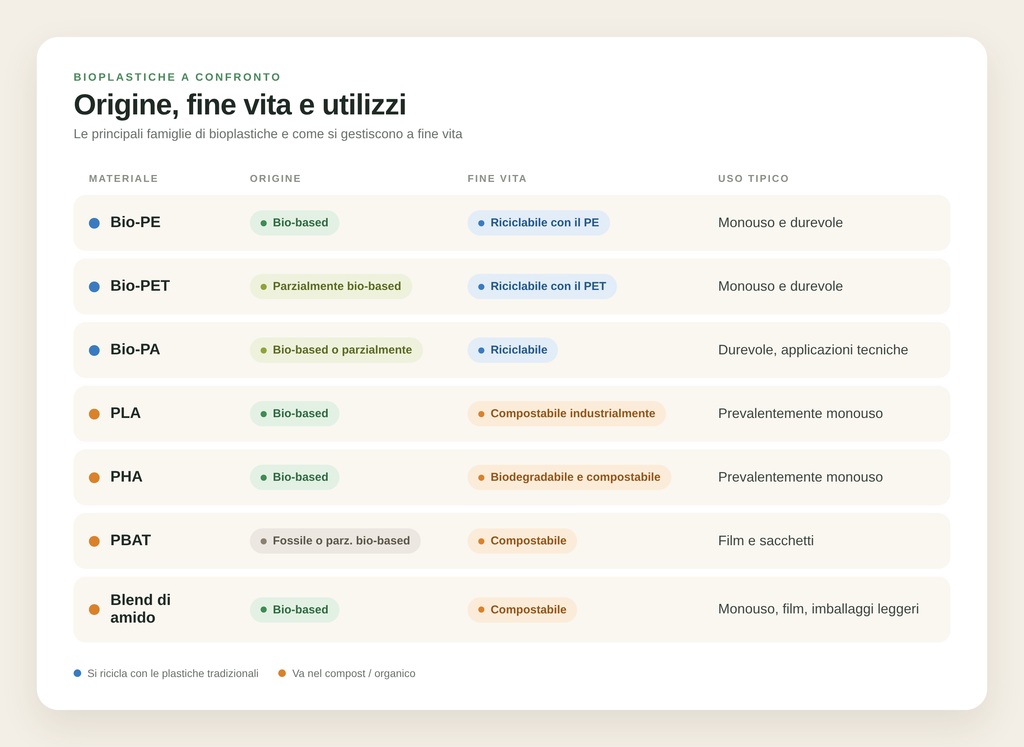
Bioplastics for industry are divided into two main families. Non-biodegradable bio-based plastics, such as bio-PE, bio-PET, and bio-PA, are also suitable for durable products and are recycled along with traditional plastics. Biodegradable and compostable plastics, such as PLA, PHA, and starch blends, are primarily indicated for single-use items and short-lived packaging. The choice depends on three factors: the product’s end-of-life, required performance, and industry regulations.
Bio-based and biodegradable: the difference that changes the choice
“Bioplastic” is an umbrella term. It indicates two different characteristics that may not necessarily coexist.
- Bio-based refers to the origin: the polymer is derived, entirely or in part, from renewable sources such as sugar cane, corn, or agri-food waste.
- Biodegradable or compostable refers to the end-of-life: the material degrades under controlled conditions, for example, in an industrial composting plant.
A bio-PE is bio-based but not biodegradable. Conversely, some compostable polymers are fossil-based, such as PBAT. For an industrial company, this distinction determines where the material can be used and how it will be managed at the end of its life.
Agri-food waste is one of the most interesting sources because it does not take resources away from the food supply chain. This is the principle behind the REKRILL® biopolymer.
What are the main bioplastics for industry
Bioplastics for single-use: when compostable is best
Compostable bioplastics perform best for short-lived products that come into contact with organic residues. In these cases, composting is a consistent end-of-life solution: packaging and food waste go into the same stream.
The most suitable areas are:
- capsules, sachets, and packaging in contact with food
- films, bags, and lightweight packaging
- disposable products for catering and events
The reason is also technical. Many compostable polymers have limited thermal resistance: PLA, for example, begins to deform around 55-60 °C. Others, such as PHA, have higher costs that are justified primarily where compostability is a requirement.
Discover our materials for sustainable food packaging.
Bioplastics for durable products
Technical components, design objects, or reusable packaging require long-term stability, mechanical resistance, and an end-of-life compatible with recycling.
Here, bio-based bioplastics designed to re-enter the plastic stream work best. So-called “drop-in” plastics, such as bio-PE and bio-PET, have the same chemical structure as fossil versions and are processed using the same equipment.
Some compostable biocomposites also find a place in durable applications. This occurs when the formulation guarantees the necessary performance and compostability is an added value rather than a usage constraint.
What to evaluate before choosing a bioplastic
Every bioplastic performs best in the context for which it was designed. Four aspects help in making the right choice:
- An end-of-life consistent with the product. A compostable material maximizes its potential in organic waste collection, while a recyclable one belongs in the plastic stream. Choosing the version suitable for the use allows for the best exploitation of the material’s characteristics.
- The correct disposal stream. Every material must be sent to the end-of-life for which it was designed. For this reason, it is advisable to clearly indicate on the packaging how to dispose of it, so as to avoid errors in collection.
- The regulatory framework. The European Single-Use Plastics (SUP) Directive also considers bio-based and biodegradable materials as plastic. The European Packaging and Packaging Waste Regulation (PPWR), however, focuses on recyclability and mandates compostability for certain specific packaging, such as tea bags and capsules. Learn more with our guide on the PPWR.
- The value across the entire project. The price per kilogram is only one of the variables. Compatibility with existing plants—which avoids investment in new equipment—continuity of supply, and the value the material adds to the product in terms of positioning and compliance also matter.
How to choose the right bioplastic for your production
Three questions help to orient the choice:
- How long does the product last? Short life and contact with organic matter suggest compostable. Long life suggests a recyclable material.
- Where will it end up at the end of its life? It must be verified that a collection stream actually exists in the sales markets.
- What performance is required? Temperature, rigidity, and processing technology quickly narrow the field.
If you have doubts about the most suitable solution, our team can help you evaluate the material based on your application.
REKRILL®: biopolymers for single-use and durable products
KRILLMAT produces the REKRILL® family of biopolymers in Italy, which are 100% bio-based and available in two versions, designed for different end-of-life scenarios.
REKRILL® COMPOSTABLE
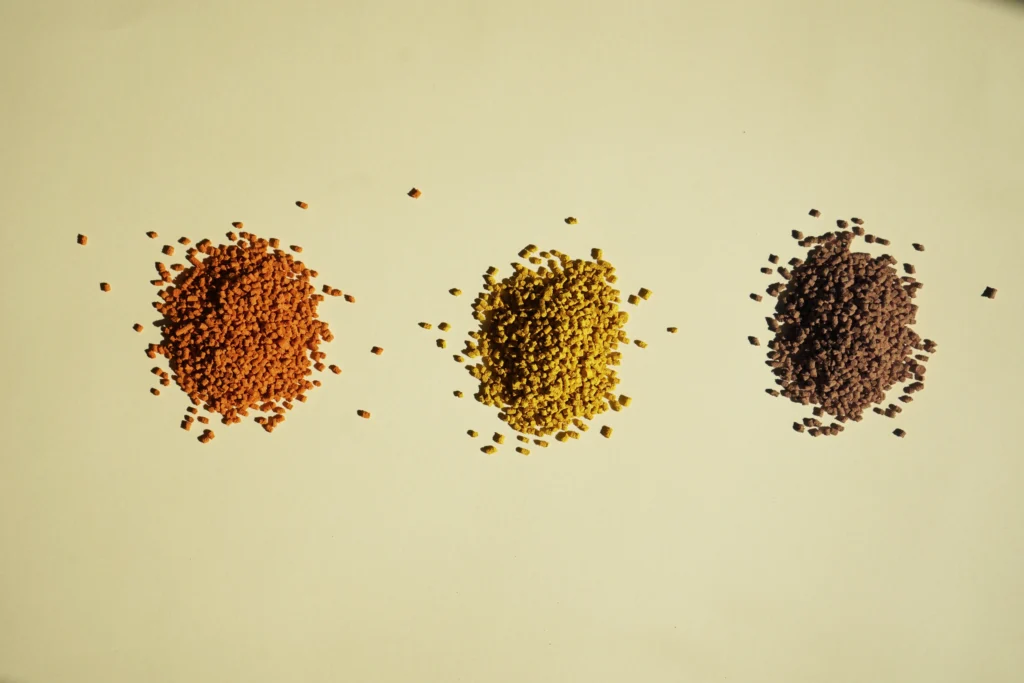
Biopolymers obtained from agri-food supply chain waste, biodegradable and compostable. Each product has its own characteristics: REKRILL® Nut, from hazelnut shells, offers rigidity and thermal stability. REKRILL® Orange, from orange peels, guarantees flexibility and high processability. REKRILL® Coffee is optimized for 3D printing, REKRILL® Bran combines rigidity and flexibility, and REKRILL® Wine stands out for its aesthetic character.
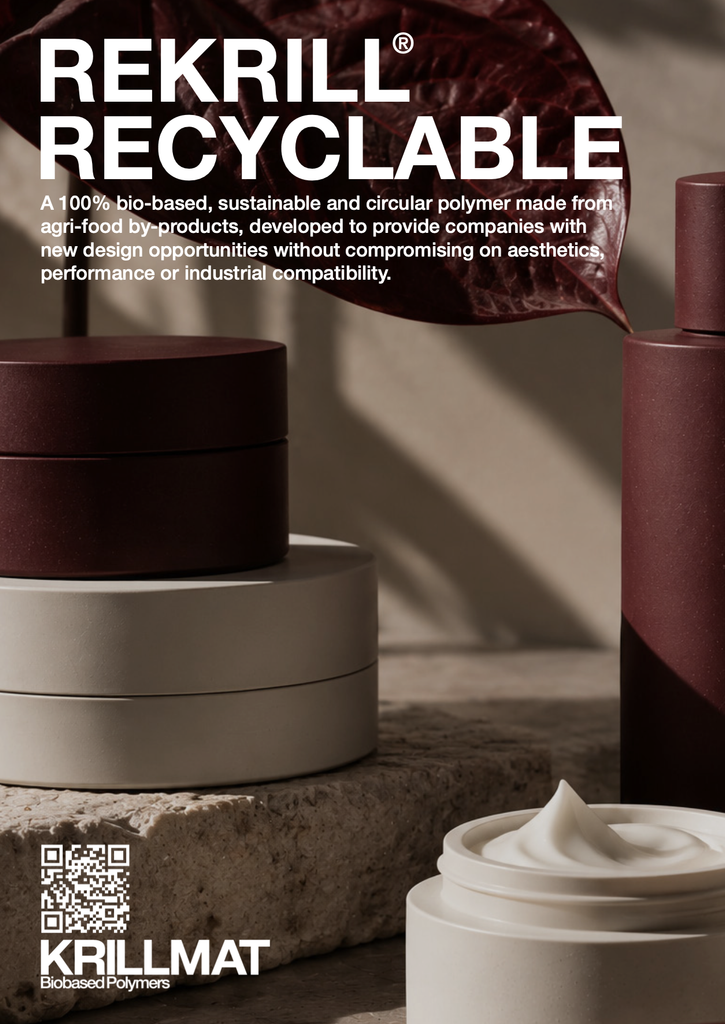
REKRILL® RECYCLABLE
100% bio-based polymer recyclable in the conventional plastic stream, designed to meet PPWR requirements. The natural fillers are the same as the compostable range, such as orange peels, coffee, bran, and grape pomace: the matrix changes, making the material recyclable. It is the solution for those seeking recyclable materials of renewable origin, even for durable applications.
Both families can be processed with the main transformation technologies without modifying plants or molds.