Zero plastic, 100% bio-based. The natural path toward truly sustainable luxury packaging.
Krill Design announces its participation in Edition Spéciale by LUXE PACK (stand D10), the leading international event dedicated to high-end sustainable packaging, to be held on July 1 and 2, 2025, at the Carrousel du Louvre in Paris. Over 100 exhibitors and 2,500 visitors from the luxury, cosmetics, wine and spirits, gourmet food, fashion, and leather goods sectors are expected at the event, all seeking innovative and responsible packaging solutions.
REKRILL®: the next-generation biopolymer for luxury packaging
At the heart of Krill Design’s proposal is REKRILL®, a patented next-generation biopolymer, the result of years of research and a radical idea: natural and industrial by-products, such as citrus peels, coffee grounds, wine residues, and bran, can be transformed into elegant, high-performance materials for the luxury world. Derived entirely from non-edible and underutilized resources, REKRILL® is biodegradable and compostable, even in marine environments, and is designed to offer the technical reliability of traditional plastics without their environmental impact.
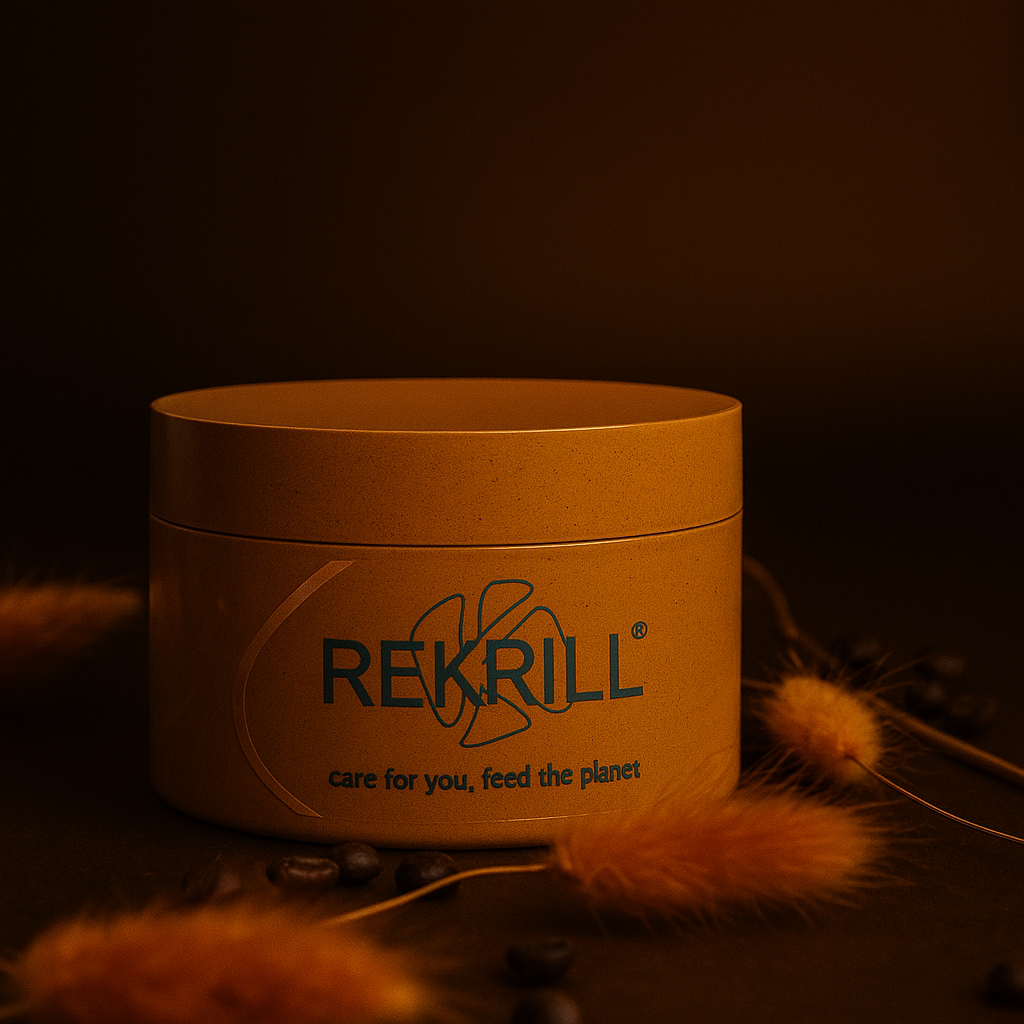
At Edition Spéciale, Krill Design will present a complete packaging solution: a jar and a lid made entirely of orange peel-based REKRILL®. Selected to compete for the LUXE PACK Green Award, this prototype embodies the core values of circular design. It transforms often-overlooked by-products into refined and desirable objects, demonstrating how luxury can evolve without losing its essence.
REKRILL® is not just a solution; it is a narrative. For brands, it becomes a tangible way to express values, vision, and commitment to the planet. Its tactile qualities, material depth, and natural origin allow it to convey meaning beyond function. It does not replace plastic by imitation; it does so by changing the rules: it offers a new starting point rooted in regeneration instead of extraction, actively reducing dependence on virgin resources.
Unlike many conventional plastics and first-generation biopolymers, REKRILL® is completely biodegradable and compostable – even in marine environments – leaving no microplastics or toxic residues, addressing a growing concern shared by brands and consumers. In terms of carbon savings, the benefits are concrete: up to 67% fewer CO₂ emissions compared to conventional plastics. Just 10 tons of REKRILL® are equivalent to the annual CO₂ absorption of one hectare of bamboo forest.
Furthermore, the REKRILL® biopolymer matches the mechanical and thermal resistance of traditional plastics, is compatible with existing plastic processing machinery, and offers a versatility of textures and applications ideal for the needs of luxury packaging.
A strategic choice for the most forward-thinking luxury brands.
In a market where sustainability is no longer a trend but a requirement, REKRILL®️ offers luxury brands the opportunity to lead change instead of following it. According to major international research conducted in 2024, 62% of consumers globally are willing to change brands for better sustainability practices, and 48% actively avoid plastic products. By choosing REKRILL®, luxury brands can strengthen their identity, reduce environmental risks, and lead the market in sustainable innovation.
What sets REKRILL® apart from other packaging materials?
What distinguishes REKRILL® is its unique combination of ethics, performance, and aesthetics. It eliminates dependence on fossil resources, drastically reduces carbon emissions, and is completely compostable, unlike traditional plastics that persist in the environment and contribute to pollution.
Unlike many first-generation bioplastics on the market, which are derived from food crops (such as corn starch) and often require industrial composting conditions, ReKrill is produced exclusively from non-edible parts of food, such as peels or shells, avoiding any competition with agricultural resources.
While some competitors focus on recycled paper, wood, or hybrid materials, ReKrill® uniquely combines the tactile and technical qualities of plastic with a fully circular, zero-waste production model, while ensuring luxury aesthetics and environmental responsibility.