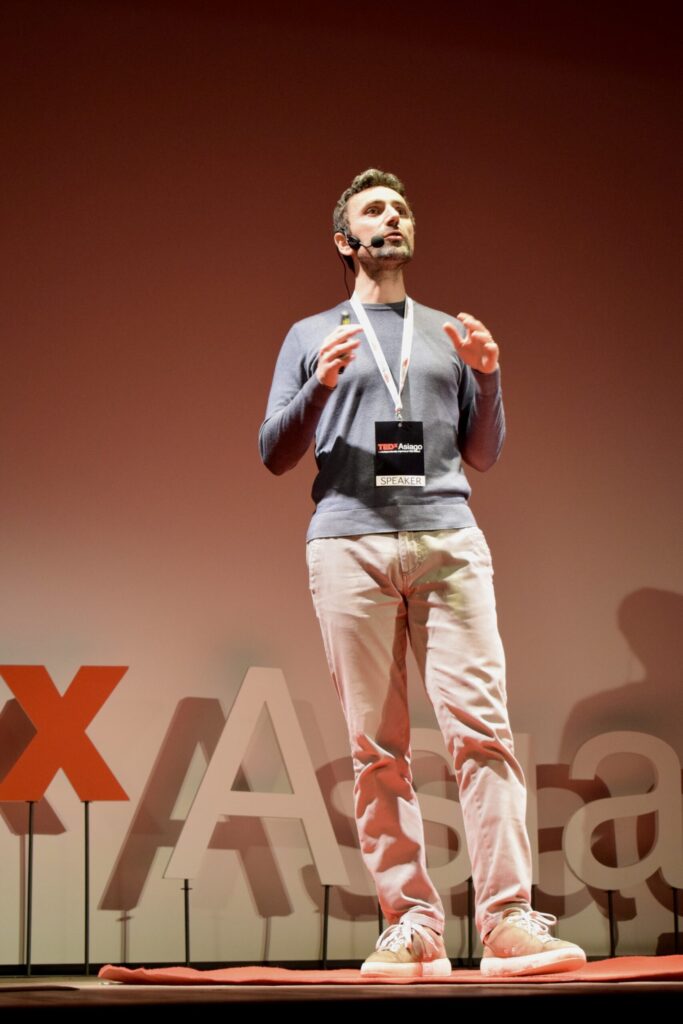
Ivan Calimani, CEO of Krill Design, will be among the speakers at the upcoming TEDxAsiago on December 13, where he will address one of the most pressing challenges facing contemporary industry: rethinking the entire production model tied to plastic by transforming food waste into a new industrial resource.
Every year, the world generates hundreds of millions of tons of plastic, of which only a minimal portion is recycled, and over one billion tons of organic waste that rarely finds a valorization pathway. In this scenario, Krill Design’s proposal opens a concrete prospect for change.
In his talk, Calimani will share the journey that led the company to develop bio-materials derived from peels, seeds, shells, and other residues from the food industry. Bio-based, biodegradable, recyclable materials free of microplastics, capable of delivering technical performance comparable to traditional plastic. From these “regenerated materials” come lamps, stools, watches, and other durable products, demonstrating how waste can become high-value-added design objects.
The speech will also explore circular supply chain projects already underway with food & beverage brands and fashion companies: initiatives in which production residues re-enter the same supply chain as new products, contributing to significant reductions in CO₂ emissions throughout the entire life cycle.
Through concrete cases, from the urban project Co.ffee Era to collaborations with major beverage companies, Calimani will demonstrate how local and scalable circular economy models can be integrated into industrial processes.
Krill Design’s presence at TEDxAsiago is an invitation to rethink the relationship between material, waste, and value. One question will guide the audience: when faced with a new object, are we certain it must be “just plastic”? Or could it instead originate from an orange, a coffee bean, or another industrial by-product?