Choosing the wrong 3D printing materials means ending up with a prototype that deforms during the first test, a component that cannot withstand heat, or an object that differs from what was envisioned during the design phase. Many problems arise even before starting the printer.
To choose the most suitable material for 3D printing, three factors matter:
- the available printing technology
- the performance required of the part
- the intended end-of-life
In filament or pellet printing (FDM and FGF), the most commonly used are PLA, PETG, ABS, nylon, and TPU, alongside biocomposites filled with natural fibers.
Resins and powders are used instead for SLA and SLS printers.
In this guide, we look at how to navigate the different options, how coloring is achieved, and which advantages and limitations to evaluate. For a manufacturing company, this is the first step toward reducing waste, prototyping times, and development costs.
Main 3D printing materials, technology by technology
Each technology processes a specific form of material. The first filter is therefore the printer you have in your department or the one you intend to purchase.
Filament and pellet (FDM, FFF, and FGF)
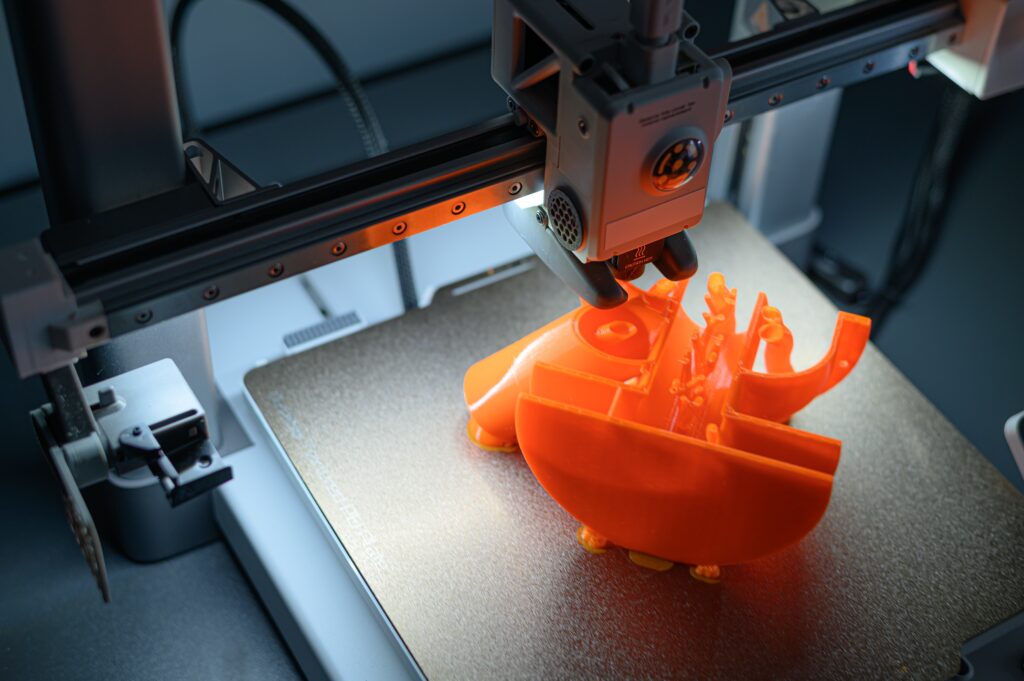
This is the most widespread family in the industrial sector. The material is melted and extruded layer by layer. Pellet printers, also suitable for large formats, use granules similar to those used in injection molding.
The most common materials are:
- PLA, easy to print and suitable for prototypes and objects not subjected to heat
- PETG and ABS, more resistant to impact and temperature
- Nylon and TPU, for technical or flexible parts
- Biocomposites, bio-based matrices filled with vegetable fibers, wood, or agri-food by-products
Resins (SLA and DLP)
Photopolymer resins guarantee extremely fine details and smooth surfaces. They are suitable for aesthetic models, precision molds, and small components.
Powders (SLS and MJF)
Polyamide powders allow for the production of functional parts without supports, with good mechanical properties. They are the typical choice for small series of technical components.
Metals
Steel, aluminum, and titanium are printed using dedicated technologies. They are mainly used in aerospace, medical, and tooling sectors.
How to choose the right 3D printing material
An effective choice starts from the final use of the part, not from the best-known material. Four questions guide the evaluation.
Prototype or finished product? For an aesthetic prototype, an easy-to-print and cost-effective material is sufficient. A part intended for real-world use, however, requires verification of resistance, durability, and compliance.
What stresses will it have to withstand? Heat, impact, bending, and contact with chemicals quickly narrow the field. A component near a heat source, for example, excludes materials with low thermal stability.
What aesthetics are needed? Color, finish, and texture matter especially for design objects, packaging, and consumer products. Some materials already offer a distinctive appearance without post-processing.
What end-of-life is planned? More and more companies must declare the impact of their products. Choosing a bio-based material that is compostable or recyclable from the development phase simplifies environmental communication and compliance.
To understand which solution fits your product, read our overview of bioplastics for industry.
Coloring: how color is obtained in 3D printing
The color of a printed part can be created in three different ways, with different results and costs.
Mass pigmentation
The color is added to the material before printing, via pigments or masterbatches. This is the most common solution: the color is uniform throughout the thickness and does not wear off with use.
Natural color of the filler
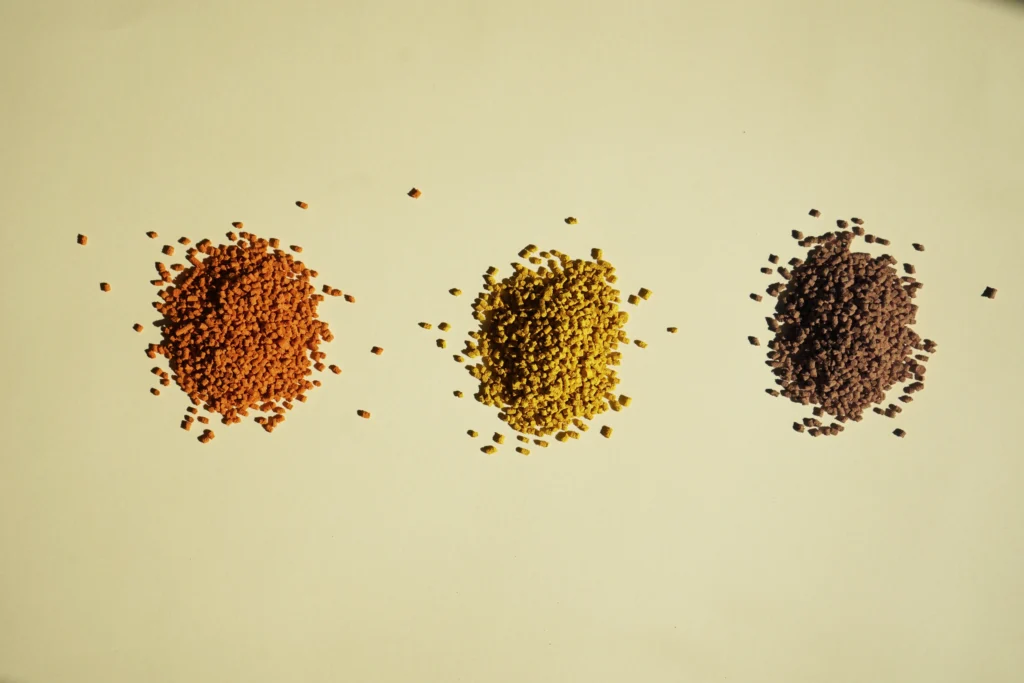
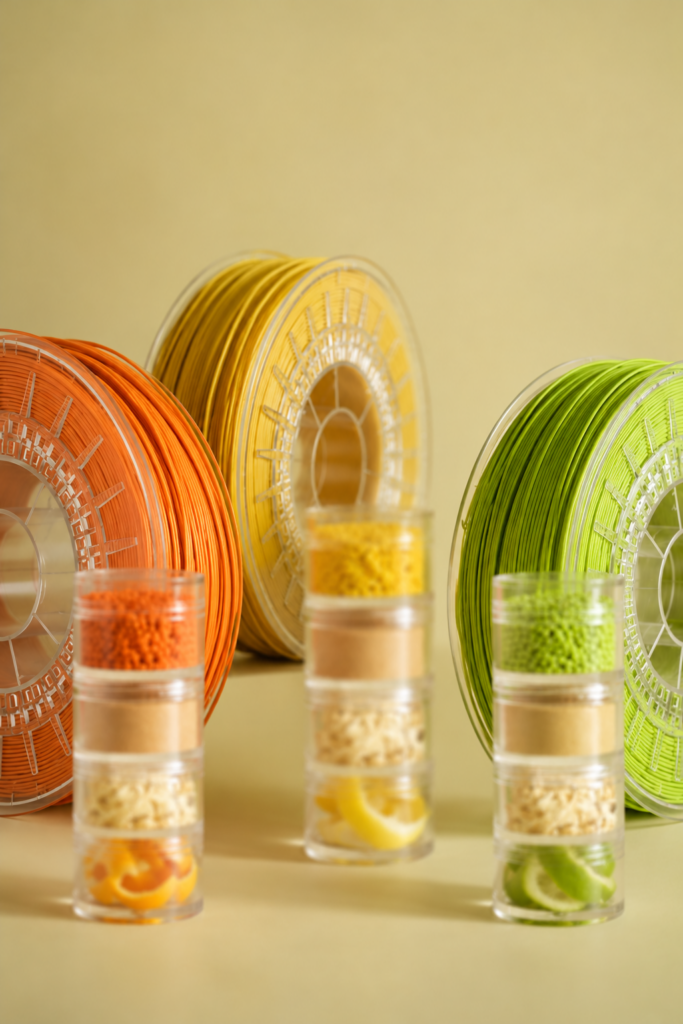
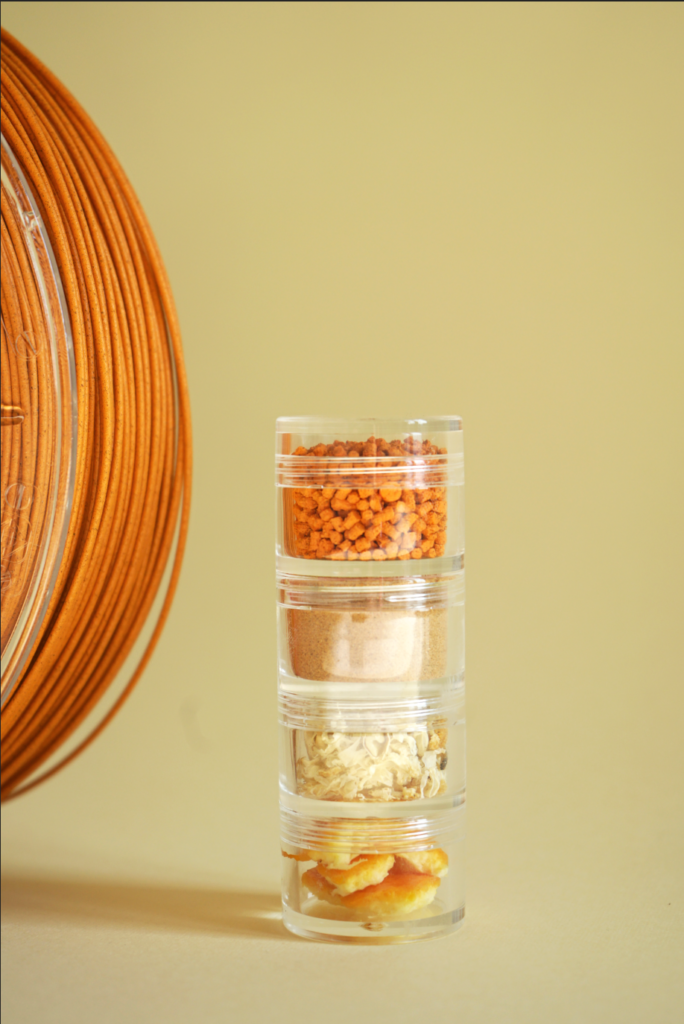
In biocomposites, the color derives from the raw material they are composed of. A material filled with coffee will have brown tones, while one with orange peels will have warm shades. The result is a textured, tactile aesthetic, with small variations that make each piece recognizable.
Post-production finishes
Painting, sanding, and surface treatments allow for any effect. However, they increase time and costs and can compromise the material’s end-of-life.
For those seeking a natural look, the most efficient solution is to start with a material that already has the desired color. Alternatively, custom colors can be developed directly in the compound.
The advantages of 3D printing for manufacturing companies
Additive manufacturing does not replace traditional processes but complements them where they are less efficient.
- No molds to create: you go from file to part without investments in equipment.
- Rapid prototyping: a design is verified in a few days and corrected before industrialization.
- Small series and customization: producing ten variants costs the same as producing one.
- Less material waste: only the amount necessary to build the part is used.
- Complex geometries: hollow shapes, lattices, and joints that are difficult to obtain with other processes.

3D printing limitations to consider
Knowing the limitations of the technology helps in using it the right way:
- Volumes and times – For large series, injection molding remains faster and more economical. 3D printing performs best on prototypes, small batches, and customized parts.
- Mechanical behavior – A part printed in layers can have different resistance depending on the printing direction. This must be considered during the design phase by orienting the part correctly.
- Surface finish – With filament technologies, print lines remain visible. For some products, this is an aesthetic feature; for others, it requires subsequent finishing.
- Material qualification – Each material must be tested on your printer with the correct temperature and speed parameters. A supplier with technical support significantly reduces this phase.
REKRILL® biopolymers for 3D printing
3D printing is in KRILLMAT‘s DNA: the company was founded by developing 3D printed objects from food waste before becoming a producer of biopolymers for industry.
Today, several REKRILL® grades are compatible with 3D printing, as well as injection molding, extrusion, and other biopolymer processing technologies.
Among these, three biopolymers stand out for their performance in additive manufacturing
- REKRILL® Coffee, obtained from coffee silver skin, is the most suitable grade. The waxy component of the skin promotes flow during printing, and the fine texture provides surfaces with a warm, natural look.
- REKRILL® Orange, from orange peels, combines flexibility and good processability even on complex geometries.
- REKRILL® Nut, from hazelnut shells, is suitable for parts requiring rigidity and thermal stability.
All grades are 100% bio-based, maintain the natural color of the source material, and can be customized with dedicated pigments. Applications range from design to packaging items.
Want to test REKRILL® on your printer? Contact us